 Ћирилица
 Latinica
 English

Understanding Stakeholder Engagement: The Quadruple Helix Approach
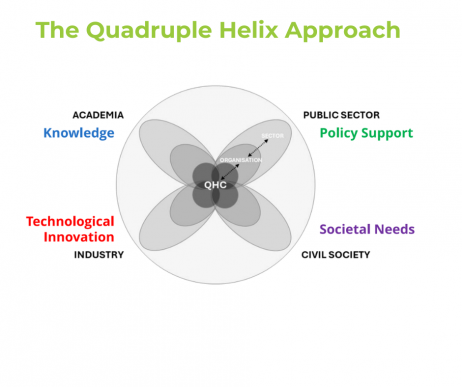
IInnovation in urban mobility does not happen in isolation. It emerges where institutions, markets, knowledge, and society intersect. One of the most influential frameworks for understanding these interactions is the Triple Helix model developed by Loet Leydesdorff, which conceptualizes innovation as the result of dynamic relationships between universities, industry, and government. In this model, knowledge production, economic development, and public policy are interwoven in a continuous process of co-evolution.
Over time, however, scholars and practitioners recognized that this model did not fully capture the complexity of contemporary innovation ecosystems. Citizens, communities, and civil society organizations increasingly play an active role in shaping public services, digital transitions, and environmental strategies. This evolution led to the development of the Quadruple Helix approach, which adds a fourth dimension: society itself.
In innovation-driven and multi-sectoral projects—particularly in fields such as sustainable mobility, environmental resilience, and digital transformation—the Quadruple Helix has become a widely adopted framework for structuring stakeholder engagement.
The Four Helices Explained
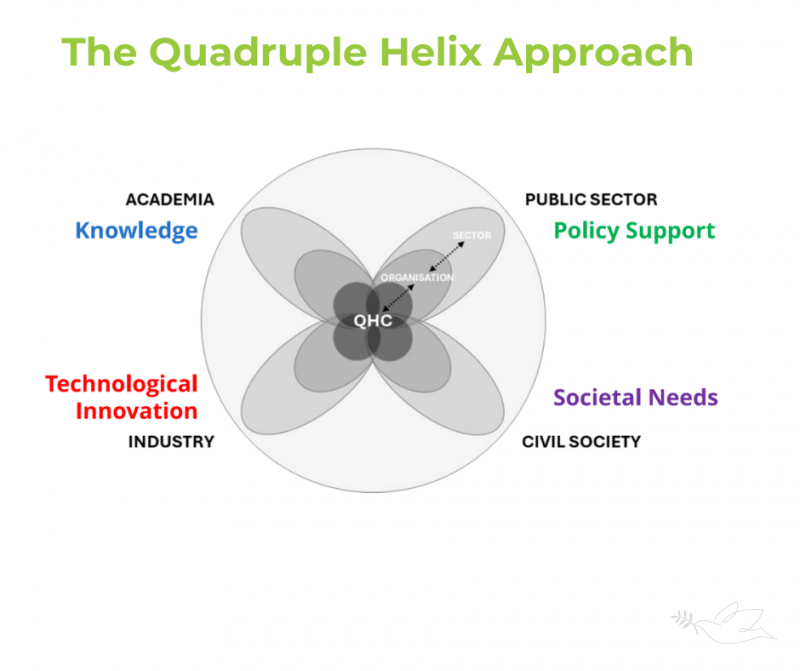
The Quadruple Helix model integrates four key actors:
- Public authorities, responsible for governance, regulation, and policy direction.
- Universities and research institutions, contributing knowledge, data analysis, and methodological expertise.
- Industry and private sector actors, developing technologies, services, and market-driven solutions.
- Citizens and civil society, representing users, communities, and social innovation networks.
- What distinguishes the Quadruple Helix from traditional consultation models is not simply the number of actors involved, but the quality of interaction. It moves beyond top-down policymaking or purely market-driven innovation and promotes co-creation, shared responsibility, and continuous dialogue.
As highlighted by Loet Leydesdorff in his foundational work on the Triple Helix, innovation systems thrive when institutional boundaries become permeable. The Quadruple Helix extends this principle by recognizing citizens as active contributors rather than passive beneficiaries.
Co-Producing Smart and Sustainable Cities
Recent research reinforces the importance of this inclusive framework. In their work on smart city assessment, Katerina Paskaleva and colleagues argue that effective smart city strategies must be co-produced rather than imposed. A Quadruple Helix perspective ensures that technological solutions align with real social needs, ethical considerations, and long-term sustainability objectives.
This insight is particularly relevant for urban mobility. Digital platforms, mobility data systems, and intelligent transport services may be technologically advanced, but without citizen engagement and cross-sector collaboration, they risk limited adoption or unintended consequences.
Similarly, the Living Lab approach discussed by Claudia I. Covelli Garrido and co-authors demonstrates how stakeholder collaboration can be operationalized in real-world urban contexts. Living Labs create experimental environments where public authorities, researchers, companies, and users jointly test solutions in real-life conditions. This methodology reinforces the Quadruple Helix principle by embedding innovation directly within the community it aims to serve.
Why Stakeholder Engagement Matters in Urban Mobility
Urban mobility systems are inherently complex. They involve infrastructure planning, behavioral change, regulatory frameworks, digital tools, environmental goals, and economic considerations. No single institution holds all the knowledge or capacity required to address these dimensions alone.
The Quadruple Helix approach strengthens stakeholder engagement by:
- Encouraging shared ownership of solutions
- Reducing resistance to change
- Enhancing transparency and trust
- Improving the relevance and usability of technological innovations
- Facilitating long-term policy alignment
In the context of sustainable mobility transitions, citizen involvement is particularly crucial. Mobility choices are embedded in daily routines, habits, and cultural expectations. Effective change therefore requires participatory processes that integrate community feedback, local knowledge, and user experience into planning and implementation.
The Quadruple Helix in the MISSION Project
The MISSION project, funded by the Interreg IPA ADRION Programme, adopts principles aligned with the Quadruple Helix framework. By connecting municipalities, research institutions, technology providers, and citizens across the Adriatic-Ionian region, the project fosters an ecosystem of collaboration rather than isolated interventions.
Through stakeholder workshops, focus groups, digital tool development, and cross-border knowledge exchange, MISSION promotes a co-creation model in which mobility solutions are not merely delivered to communities but developed with them. This approach reflects the broader understanding that sustainable urban mobility requires both technological innovation and social innovation.
From Participation to Co-Creation
Stakeholder engagement is often interpreted as consultation. The Quadruple Helix challenges this limited perspective. It calls for a shift from informing and consulting stakeholders to empowering them as co-designers and co-implementers of solutions.
In practice, this means integrating participatory methodologies, ensuring data transparency, facilitating interdisciplinary collaboration, and maintaining open communication channels throughout the project lifecycle. It also means acknowledging that innovation is iterative and that feedback loops are essential for continuous improvement.
Building Resilient Innovation Ecosystems
The Quadruple Helix approach ultimately supports the development of resilient innovation ecosystems. By weaving together governance, knowledge, markets, and society, cities can better navigate the uncertainties of digital transformation and climate transition.
For projects like MISSION, understanding and applying the Quadruple Helix is not a theoretical exercise. It is a practical framework for ensuring that mobility solutions are inclusive, context-sensitive, and sustainable over time. In a rapidly changing urban landscape, collaboration is not optional—it is the foundation of meaningful innovation.
You could be interested in:
Leydesdorff, L. (2012). The Triple Helix of University-IndustryGovernment Relations Paskaleva,
K., Evans, J., & Watson, K. (2021). Co-producing smart cities: A Quadruple Helix approach to assessment.
Covelli Garrido, C. I., Giovannini, A., Mangone, A., & Silvestri, F. (2023). Managing Urban Mobility during Big Events through Living Lab Approach.
Contact information
Phone:
+381 21 420-066
Address:
Trg slobode 1
21101 Novi Sad
Republic of Serbia